
PV Sizing for Solar Water Pumps: Why More Panels Can Extend Pumping Hours
Quick answer
A larger PV array may extend useful pumping hours, but the right configuration depends on water demand, head and the selected inverter.
A customer has an AC irrigation pump and wants to operate it from solar panels. One of the first questions is: “How many kilowatts of panels do I need?”
Pump power is a starting point. A useful answer also needs the daily water target, total dynamic head, local solar conditions and the electrical limits of the selected solar pump inverter.
For B2B suppliers, the objective is a configuration that delivers the required water within an agreed operating window.
What the INTA field example shows
Argentina’s National Institute of Agricultural Technology, INTA, reported an off-grid subsurface drip irrigation application at its Manfredi experimental station in September 2026.
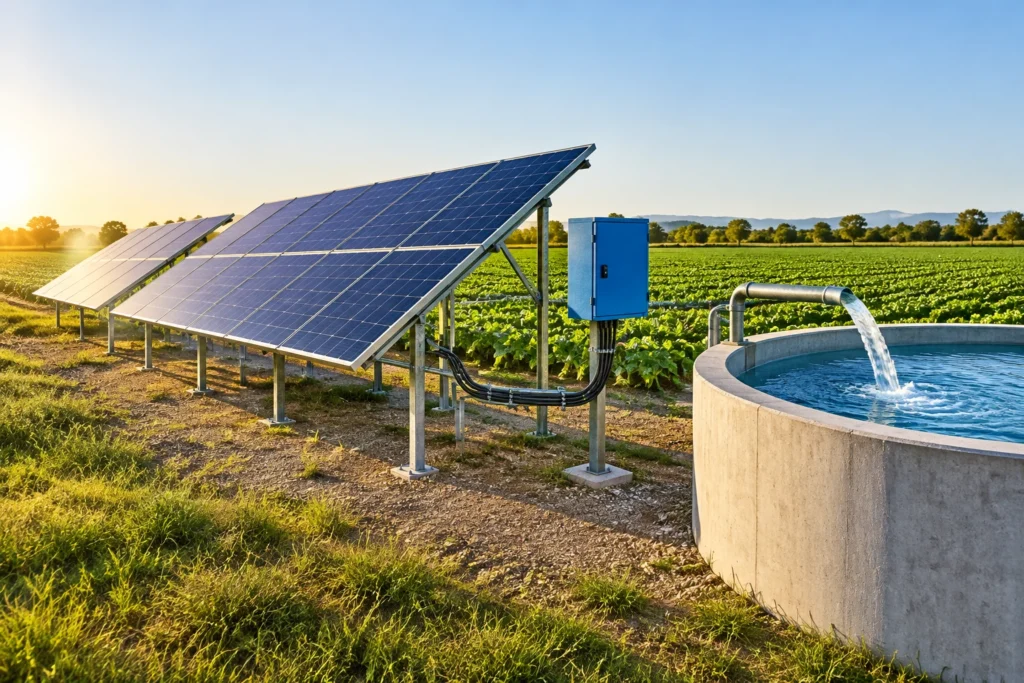
The installation used a 10 kW solar pump with a reported flow of 24 m³/h and an 18 kW PV array. Researchers explained that the larger array extended operation when solar radiation fell below its maximum.
The same infrastructure initially irrigated 6 hectares and later served 12 hectares after water application was adjusted to crop requirements.
This is a third-party field example using a Lorentz pump, not a HOBER AC-pump retrofit. The official article describes research experience rather than a complete electrical design or independently reproducible performance dataset.
Source: INTA, published September 29, 2026.
Why the 1.8 ratio is not a universal rule
Dividing the reported PV capacity by pump power gives 1.8. That arithmetic describes this installation; it does not determine the correct ratio for another site.
A different project may have a different head, seasonal water requirement, module temperature, pump efficiency or inverter input limit. Even the meaning of “pump power” needs checking: motor shaft output and electrical input are different quantities.
PVsyst’s pumping system sizing guidance presents power ratios as rough starting estimates and calls for detailed simulation with actual devices. It also notes the trade-off: a larger array may leave energy unused in clear conditions, while a smaller array may reduce performance at low irradiance.
The engineering question is therefore: what additional water does the proposed array deliver, and when is that water needed?
Separate three decisions in the quotation
| Decision | Information required | Result to confirm |
|---|---|---|
| Pump selection | Required flow, total head and pump curves | Pump can meet the hydraulic duty |
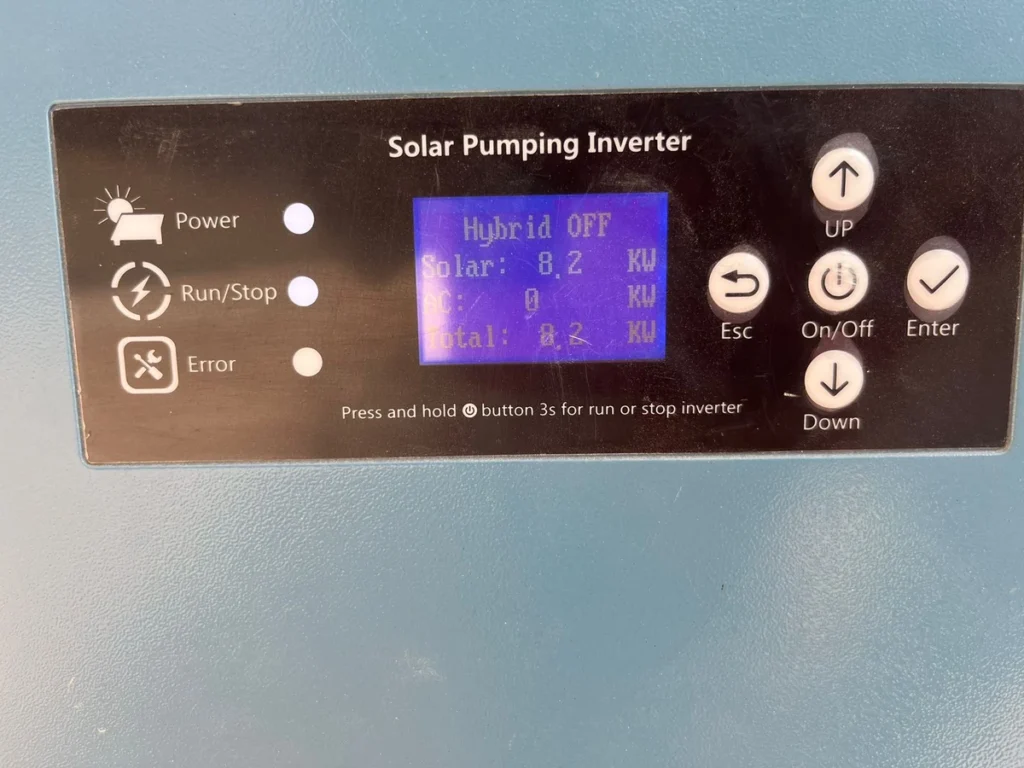
| Inverter matching | Motor type, voltage, phase, frequency and current | Documented compatibility and adequate drive rating |
| PV configuration | Site conditions, module data and inverter DC limits | Suitable array capacity and series/parallel arrangement |
Manufacturer Nastec’s PV sizing guidance similarly distinguishes motor output power from electrical input and uses motor voltage and rated current for drive selection. Its numerical voltage rules apply to its own equipment; HOBER projects must use the selected HOBER model’s specifications.
A practical PV sizing workflow for installers
The following workflow is HOBER’s engineering recommendation for preparing a project inquiry.
1. Agree on the water target
Collect daily volume, required delivery pressure and seasonal demand. Establish whether water must be available at specific times or can be stored for later use.
“Run the pump all day” is an operating preference. It still needs to be translated into a measurable water requirement.
2. Confirm the hydraulic duty
Use the pumping water level, discharge elevation, pressure requirement and pipeline losses. Match the duty against the actual pump curve before calculating array options.
For an existing AC pump, also obtain recent operating readings where available. A retrofit proposal should begin with the installed equipment and measured conditions.
3. Verify the motor and inverter
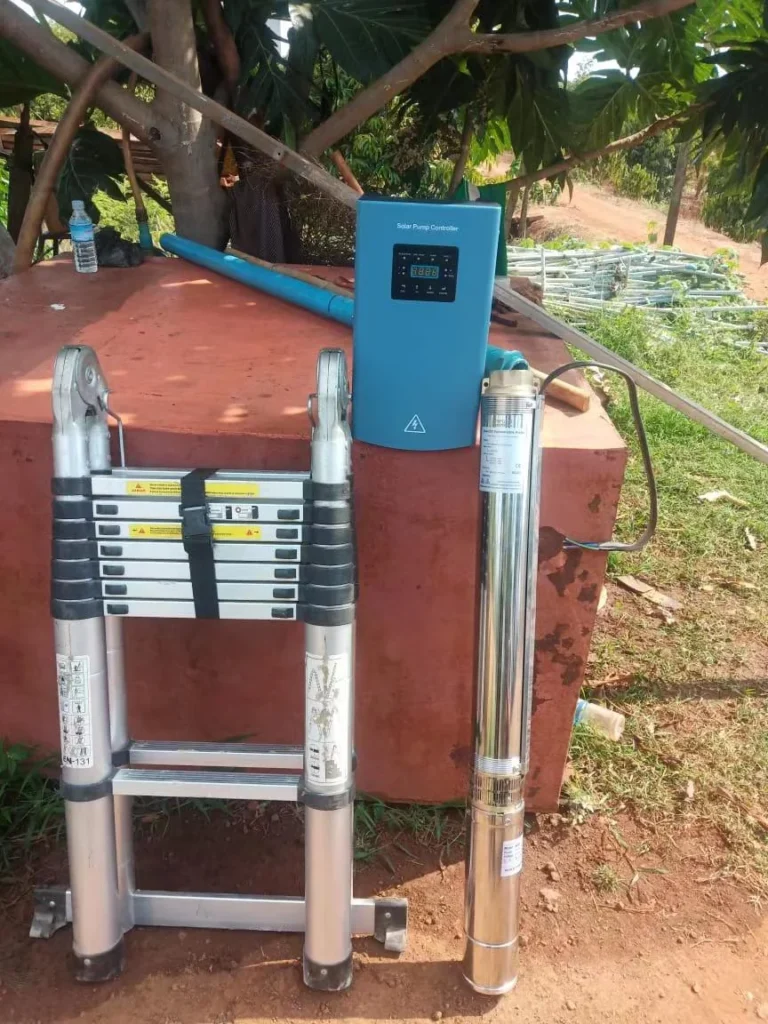
Request a clear nameplate photograph and the pump model. Confirm compatibility, current rating and any application-specific requirements.
A larger PV array does not authorize operation above the motor’s permitted frequency, the pump’s operating range or the inverter’s output rating.
4. Check the full PV electrical configuration
Review the proposed module and string arrangement against the selected inverter’s documentation:
- Maximum DC voltage, including the cold-condition open-circuit voltage.
- Operating voltage range under the expected temperature conditions.
- Permitted input current, short-circuit current and PV capacity.
- Cable, switching and protection requirements.
Adding modules in series changes voltage; adding strings in parallel changes current. Equal total array power does not make two configurations electrically interchangeable.
5. Compare useful water delivery
Compare feasible array options using site weather, pump performance and storage assumptions. Ask for expected seasonal water delivery and the assumptions behind it.
Useful extra pumping time depends on overcoming the system head and remaining within the equipment’s operating limits. An earlier motor start is not automatically an earlier delivery of water.
6. Define commissioning acceptance
Before installation, agree on the records needed to assess performance: PV input conditions, output frequency, motor current, flow, pressure and pumping water level.
Compare measurements taken under documented conditions with the design estimate. Avoid unconditional daily-volume promises based only on installed panel wattage.
What distributors should send with an inquiry
Provide the destination and installation location, motor nameplate, pump curve, required daily water volume, total head and proposed PV module datasheet. Add storage capacity and grid or generator availability where relevant.
Start with Solar Pumping Inverter Selection for an Existing AC Pump or New Solar Pump Selection. For a project review, contact HOBER with the site data.
An online model recommendation is an initial selection. Final PV configuration and water delivery should be confirmed against the actual installation.
Project step
Need flow data, constant pressure or remote monitoring on a pumping project?
Send the water source, the required flow, the total head and the pump voltage — HOBER answers with a matched configuration.
References
- INTA Manfredi. Riego con energía solar: claves para trabajar sin conexión a la red. September 29, 2026. Official source.
- PVsyst. Pumping system sizing. Official documentation. Accessed October 26, 2026.
- Nastec. PV system sizing. Manufacturer guidance. Accessed October 26, 2026.