
HOBER Hybrid Solar Pump Inverter: How It Works & 5 Modes
Quick answer
Learn how HOBER hybrid solar pump inverters combine solar and grid power, support existing AC pumps, and offer five smart operating modes.
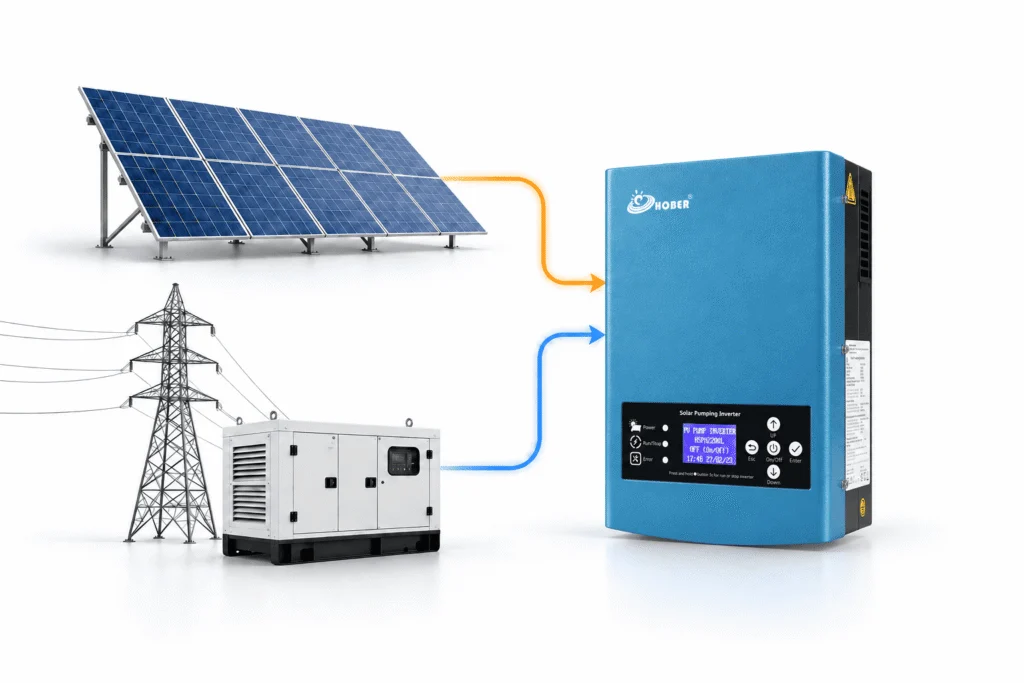
A HOBER hybrid solar pump inverter uses electricity from solar panels to run a compatible AC water pump. On hybrid-capable models, a connected grid supply can supplement solar power when sunlight is insufficient, or operate the pump when solar is unavailable. The result is more flexible pumping hours without necessarily replacing the existing AC pump. Actual behavior depends on the selected operating mode, inverter model and system settings.
For solar pump distributors, installers and EPC contractors, the practical question is simple: How can a customer use as much solar energy as possible while still meeting their water demand? HOBER’s hybrid control is designed for that question.
What Is a Hybrid Solar Pump Inverter?
A hybrid solar pump inverter is a dedicated motor drive that converts solar-panel DC electricity into controlled AC power for a water pump and, on supported models, also accepts an AC supply from the grid or a compatible generator.
It is different from a household hybrid inverter. Its primary job is to control a pump motor, respond to changing solar power and support the required pumping duty. A battery is not required for the normal solar-plus-AC arrangement.
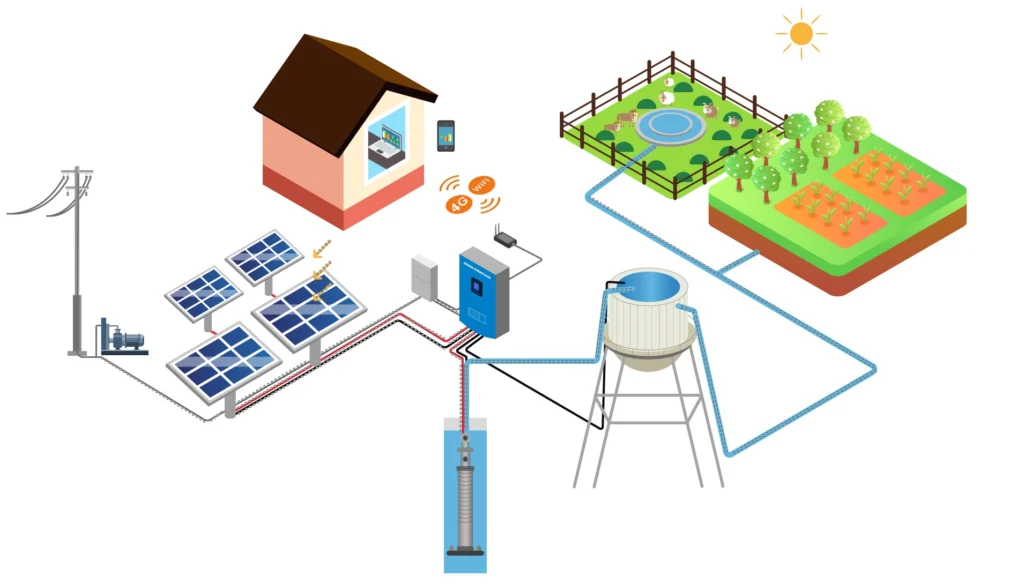
In a typical HOBER installation:
- Solar panels generate DC electricity.
- The HOBER solar pump inverter controls the AC pump motor and manages the available input power.
- The grid or a compatible generator provides AC support when required by the selected hybrid mode.
- The AC water pump moves water into a tank, irrigation network or supply line.
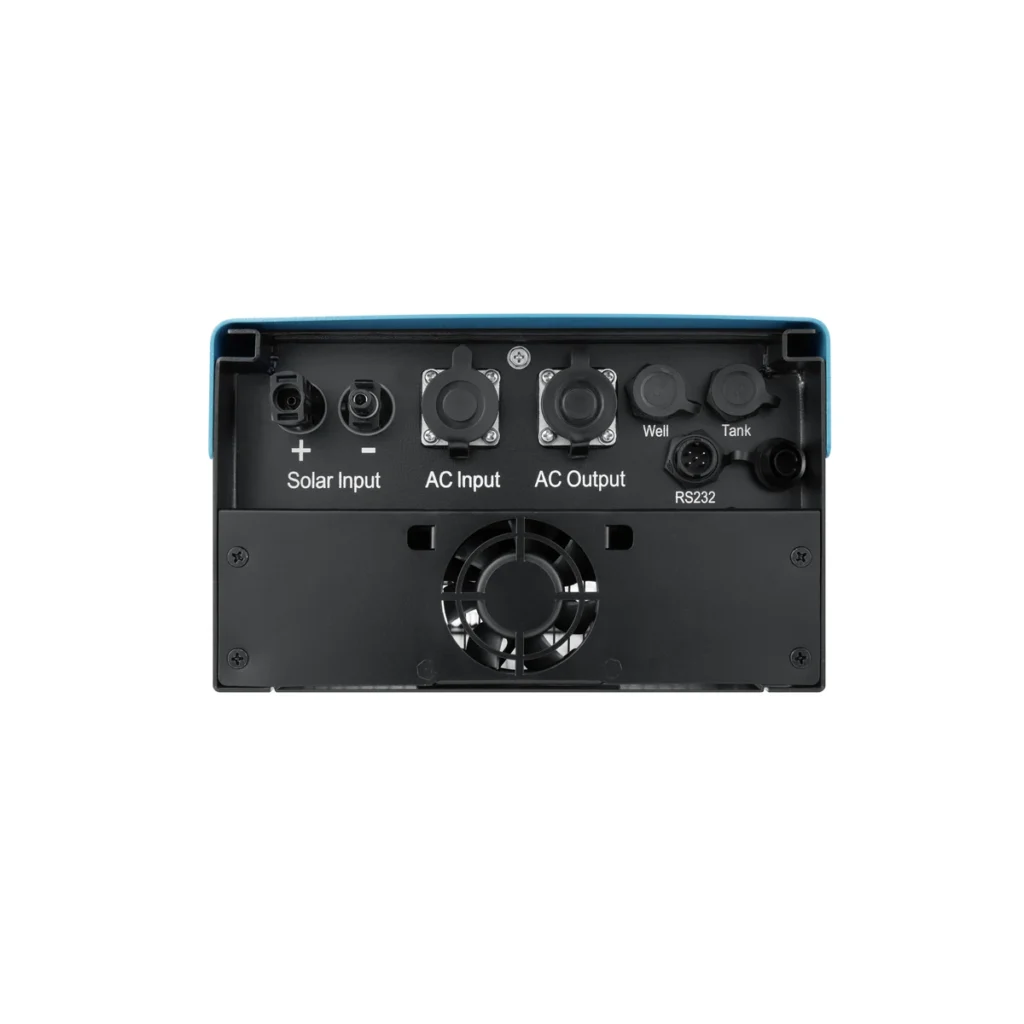
This can be an efficient route to solarizing an existing AC pump, provided its voltage, phase, rated current and operating duty match a suitable HOBER inverter.
How Does Solar Priority Work?
Solar Priority means solar power is used first. When the available solar power is too low for the requested pump operation, the inverter can automatically draw supplementary power from the connected AC source. When solar production recovers, the need for AC support decreases.
Consider a typical irrigation site:
- Strong sunshine: The solar array can supply the required pump power, so grid consumption may be minimal or zero.
- Passing clouds: If solar output falls below the required level, AC power can help maintain the configured pumping operation.
- Late afternoon: As solar generation declines, the system may need more AC support.
- Night: Grid Only operation can run the pump without solar input, when grid power is available and that mode is configured.
This is power supplementation, not simply an all-or-nothing change from solar to grid. The exact control response is subject to the selected model, settings and power-source conditions.
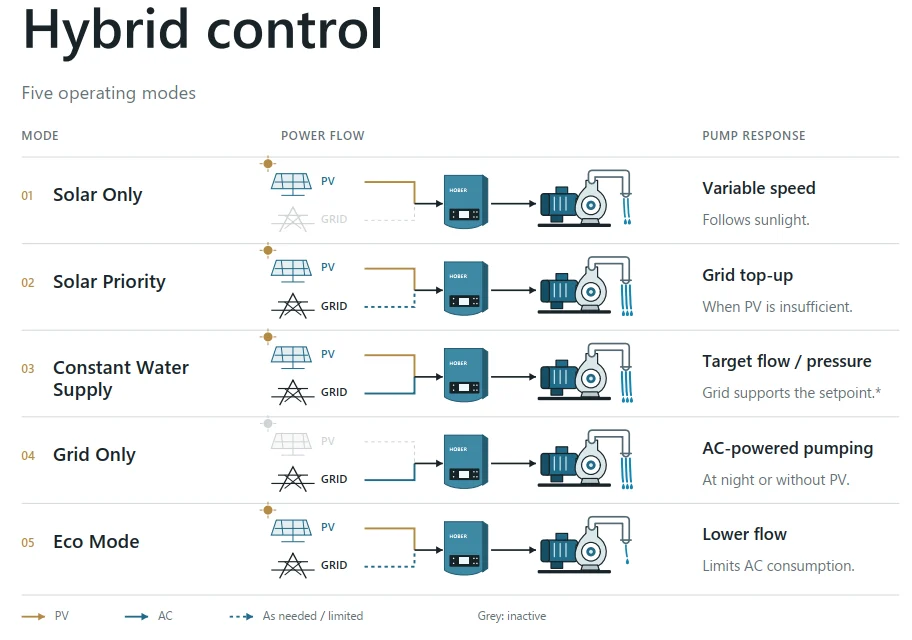
HOBER’s Five Hybrid Operating Modes
HOBER’s hybrid-control concept provides five modes for different water supply priorities. Check the selected model and firmware for mode availability before specifying a project.
| Mode | What the pump does | Best suited to |
|---|---|---|
| 1. Solar Only | Uses solar power; pump speed follows available sunlight. | Daytime water transfer and tank filling where variable flow is acceptable. |
| 2. Solar Priority | Uses solar first; AC power supports operation when PV power is insufficient. | Irrigation projects aiming to reduce grid consumption while extending pumping hours. |
| 3. Constant Water Supply | Works toward a configured flow or pressure target, using AC support when needed. | Pressure-sensitive or duty-controlled systems with the appropriate sensor/control configuration. |
| 4. Grid Only | Runs the pump from the AC supply without relying on sunlight. | Night pumping, poor solar conditions and grid-powered operation. |
| 5. Eco Mode | Limits AC support and can accept lower pumping output to reduce electricity use. | Applications where lower flow is acceptable and AC consumption should be constrained. |
Important: Constant Water Supply should not be described as a guaranteed fixed flow or pressure under every condition. It depends on correct sizing, available power, hydraulic conditions and any required pressure or flow feedback equipment.
Which Hybrid Mode Should an Installer Choose?
The best mode depends on water demand, not just the weather.
Choose Solar Only when variable daytime flow is acceptable
For a tank-filling application, the pump can run faster in strong sunshine and slower in weaker sunlight. A correctly sized water storage tank can help match variable daytime pumping to demand later in the day.
Choose Solar Priority when pumping hours matter
An agricultural customer may already have a grid-connected AC borehole pump but want to offset part of the electricity bill with PV. Solar Priority offers an approach: retain a compatible pump, add solar power through a matched HOBER inverter, and use the grid only when additional input is needed.
Choose Constant Water Supply when the duty target matters
Pressure boosting or controlled irrigation may need a target pressure or flow. In such cases, the system needs the appropriate control feedback and enough combined available power. An installer should verify the required sensor, settings and pump curve instead of assuming this mode alone solves an undersized system.
Choose Grid Only for planned AC-powered operation
Where grid electricity is available, the pump can operate without solar input—such as at night. This is not a claim that pumping can continue during a grid outage if no other source is available.
Choose Eco Mode when lower flow is an acceptable trade-off
Eco Mode is useful where limiting purchased electricity is more important than maintaining the maximum water output at every moment. It should not be selected for a project with a non-negotiable minimum flow without checking its performance.
Can a HOBER Hybrid Inverter Work With an Existing AC Water Pump?
Yes, when a compatible HOBER model is selected. This is one of the strongest practical advantages for pump distributors and installers: solar conversion may not require replacing the customer’s installed AC pump.
Before selection, collect:
- Pump motor power (kW or HP), rated voltage, phase and current.
- Required flow (m³/h) and total dynamic head (m), including pipe losses.
- Current pumping hours and daily water requirement (m³/day).
- Available PV modules and proposed string configuration.
- Grid or generator voltage, phase and frequency, if AC backup is planned.
- Cable length, protections and any pressure, flow or tank-level controls.
The pump and its required duty come first. After matching the motor to the inverter, size the solar array and confirm the particular inverter’s DC input range and hybrid AC input specifications. Hybrid designs may require a different minimum PV operating voltage from solar-only installations, so do not reuse a solar-only string design without checking the datasheet.
For model-level specifications, see HOBER Solar Pump Inverters and the Hybrid Solar Pumping Solution.
What Are the Main Benefits for Distributors and Installers?
1. Offer solar conversion without automatically replacing the pump
Many customers already own a functioning AC submersible or surface water pump. A suitable hybrid inverter creates an upgrade path that reuses that asset instead of making a completely new pump purchase the default recommendation.
2. Reduce dependence on grid electricity
Solar energy can offset grid consumption during daylight hours. Actual savings are site-specific: they depend on PV generation, pump demand, local electricity tariffs, operating mode and the number of hours the pump runs.
3. Support longer pumping schedules
With a correctly configured AC source, hybrid operation can serve sites where the water requirement extends beyond the available solar window.
4. Match the control strategy to the application
A borehole-to-tank project and a constant-pressure irrigation project should not use identical assumptions. The five modes help installers explain the choices to customers in practical terms.
5. Give customers a clear upgrade path
For wholesalers, a hybrid-capable solar pump inverter can support two common sales conversations: new solar pumping systems and conversion of existing AC pumps to solar-assisted operation.
Common Hybrid Pumping Mistakes to Avoid
Mistake 1: Assuming all solar pump inverters accept AC input. Confirm the hybrid input on the exact model’s datasheet.
Mistake 2: Designing the PV strings for solar-only conditions. Verify the inverter’s minimum operating voltage and maximum permitted open-circuit voltage for hybrid use.
Mistake 3: Promising constant pressure without checking feedback. Confirm the pressure or flow sensor and the control configuration required by the project.
Mistake 4: Promising 24/7 pumping without a dependable backup source. Night operation requires sufficient AC power (or another properly designed source), and pump or system protections may stop operation when necessary.
Mistake 5: Matching by kW alone. Pump voltage, phase, current, hydraulic duty and field conditions matter as much as rated power.
Project step
Need flow data, constant pressure or remote monitoring on a pumping project?
Send the water source, the required flow, the total head and the pump voltage — HOBER answers with a matched configuration.
FAQ: Hybrid Modes, Grid Backup and Existing Pumps
Does a HOBER hybrid solar pump inverter need batteries?
No. In a standard solar-plus-grid pumping configuration, the inverter uses available solar DC and supported AC input directly. Water storage is often considered separately from electrical energy storage.
Can solar and grid power work together?
Yes, on supported hybrid models and in the appropriate operating mode. The grid can supplement available PV power when the solar input is not sufficient for the selected pumping operation.
Can the pump run at night?
Yes, if a suitable AC supply is available and the inverter is configured for grid-powered operation. Solar panels alone do not power the pump at night.
Can I keep my existing AC borehole pump?
Often yes. HOBER selects the inverter against the existing pump’s nameplate and actual duty. Compatibility must be confirmed before ordering.
What is the difference between Solar Priority and Eco Mode?
Solar Priority allows AC support to help meet the requested operation when PV is insufficient. Eco Mode limits AC use and may permit lower flow. The right choice depends on whether water output or electricity conservation is more important.
Can a generator replace grid power?
Potentially, on compatible models. Generator voltage, frequency, capacity and stability must be checked against the inverter and pump requirements before specifying the system.
Will Hybrid Mode guarantee uninterrupted water supply?
No inverter can guarantee that by itself. Pumping still depends on a suitable and available power source, sufficient water in the source, correct sizing and protective controls. Hybrid operation improves supply flexibility; it does not remove site constraints.
Get a Hybrid Solar Pump Inverter Matched to Your Project
For a distributor, installer or EPC contractor, the fastest way to assess a hybrid conversion is to send the pump nameplate, required flow and head, available PV details, and AC backup supply.
HOBER can then review the application and recommend a suitable solar pump inverter and configuration for the required operating mode.